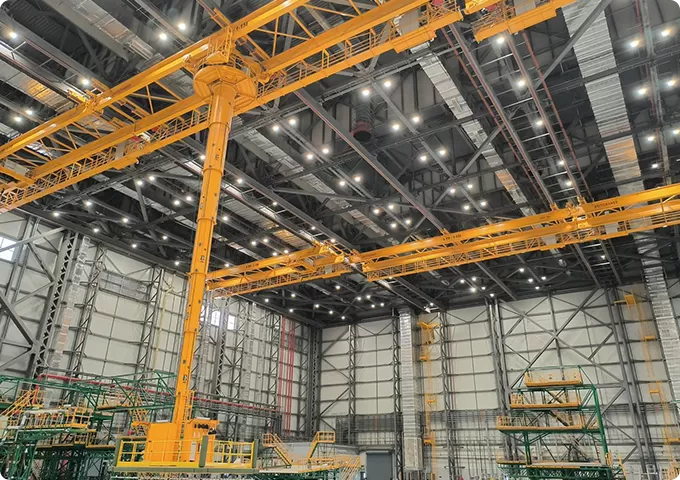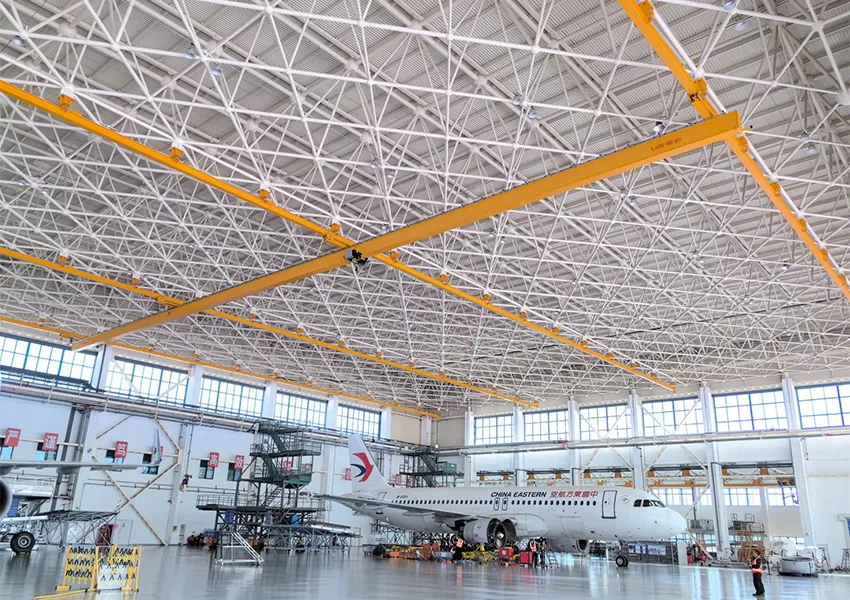





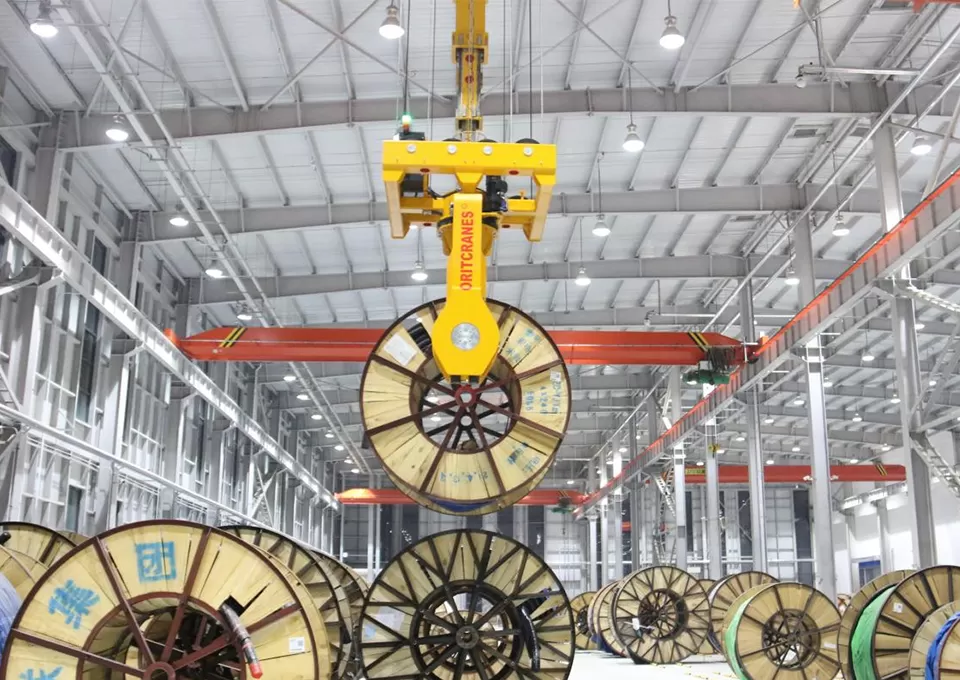

For large-span aircraft hangars, a multi-point suspension crane is often more practical than a conventional long-span bridge crane. By distributing the crane and lifted load across several suspension points, the system reduces concentrated structural loads, controls girder deflection, and provides wide lifting coverage without adding floor-level support columns.
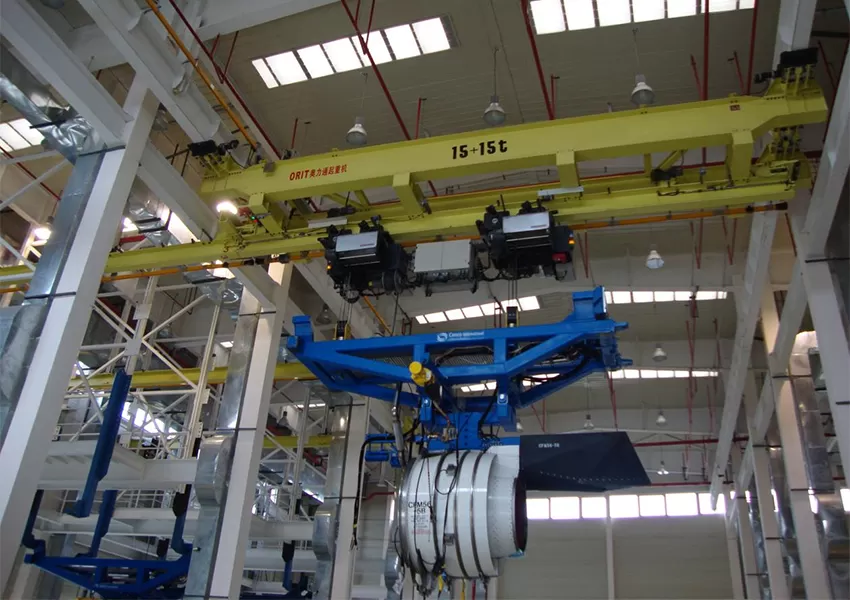
For aircraft MRO and manufacturing facilities, this means a hangar crane can cover wings, fuselage sections, engines, tooling, and maintenance areas while preserving the clear floor space required for aircraft movement.
Aircraft hangars create an unusual crane-design challenge: very large building spans combined with strict requirements for low self-weight, accurate positioning, and unobstructed working space.
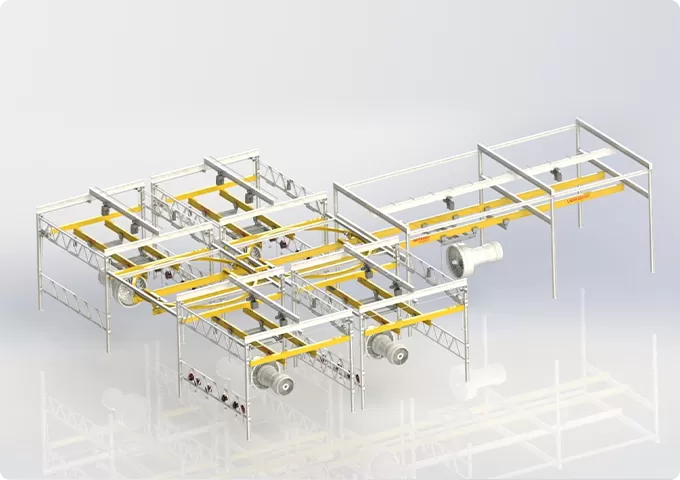
Instead of attempting to support the entire crane span from only two ends, a multi-point system introduces intermediate suspension points. The load is therefore shared across several roof or runway locations.
The main advantages include:
Lower concentrated loads on the hangar structure
Reduced bridge-girder bending and deflection
Greater practical coverage across wide bays
Less crane dead weight compared with some conventional long-span solutions
No additional floor columns interfering with aircraft or docking systems
Roof-supported suspension cranes are already used in aviation facilities because they can maximize available floor space and lifting coverage.
The engineering issue is not simply adding more suspension points. Load sharing and travel synchronization must be controlled correctly.
With a very long crane, structural deflection, runway tolerances, eccentric loading, and differences between travel drives can create skewing or wheel-loading problems. A properly engineered multi-point system coordinates the suspension points so the crane travels as one controlled structure.
For aircraft handling, variable-frequency drives and anti-sway control are particularly valuable because engines, fuselage assemblies, tooling, and other aviation components frequently require slow and accurate positioning.
ORIT's aircraft hangar crane system combines multi-point suspension with variable-frequency control and anti-sway technology. Its published design range allows span adjustment by changing the number of suspension points, with total spans of up to 100 meters.
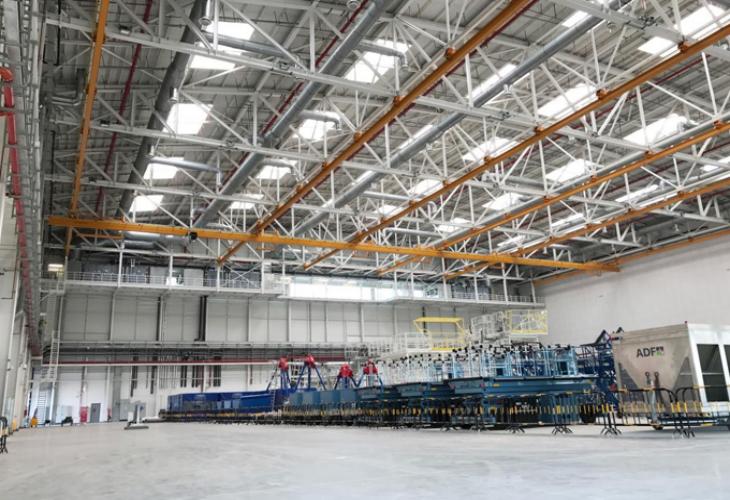
There is no standard number that suits every project.
The correct number depends on:
Total crane span
Rated lifting capacity
Roof-truss or space-frame geometry
Allowable structural reactions
Crane self-weight
Required hook coverage
Aircraft maintenance layout
Runway alignment and deflection limits
For example, ORIT references an A330 MRO hangar installation using six suspension points, a 10-ton lifting capacity, and a total span of 76 meters including girder overhangs.
This illustrates why suspension-point selection should be treated as part of the building-and-crane structural design rather than simply as a crane specification.
For buyers researching crane point industrial lifting solutions, rated capacity alone is not enough. In large aircraft hangars, the relationship between the crane and the building structure is equally important.
Crane suppliers and structural engineers should evaluate roof reactions, suspension-point spacing, allowable deflection, runway tolerances, dynamic loads, synchronization, headroom, maintenance access, and future aircraft requirements.
Early coordination is especially important. Designing the crane after the hangar structure has already been finalized can restrict lifting coverage or require expensive structural reinforcement.
A multi-point suspension hangar crane provides an effective solution for large-span aircraft MRO and manufacturing facilities where wide coverage, low structural loading, clear floor space, and precise handling are priorities.
The best system is not determined only by tonnage or span. Suspension-point layout, roof capacity, travel synchronization, structural deflection, and maintenance workflow should be engineered together. For very wide hangars, this integrated approach can deliver a lighter, more stable, and more flexible lifting system.
It is an underhung crane supported at multiple points along its span rather than only at both ends, helping distribute loads across a wide structure.
It keeps the floor clear while providing overhead lifting coverage for engines, aircraft components, tooling, and maintenance equipment.
Yes. Multi-point suspension makes very large spans practical. ORIT specifies configurations reaching up to 100 meters.
Yes. When combined with synchronized drives, variable-frequency control, and anti-sway functions, they can provide controlled, accurate load positioning.
Provide the hangar dimensions, roof structure, required lifting capacity, hook coverage, lifting height, aircraft type, duty requirements, and available structural drawings.